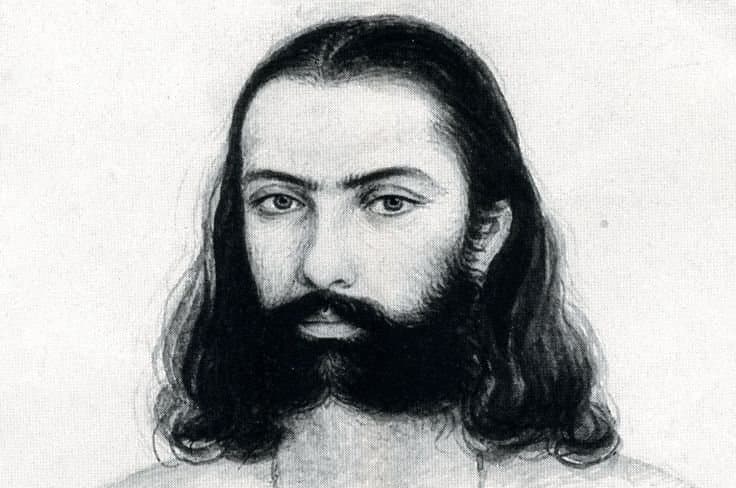
Momin Khan Momin
A master of the classical Urdu ghazal and a contemporary of Ghalib — Momin was the poet of love's tender ache, whose verses Ghalib himself is said to have envied.
Momin Khan Momin (1800–1852) belongs to that rare generation of Delhi poets who turned the Urdu ghazal into one of the world's great vehicles of feeling. He shared his city and his age with Ghalib and Zauq, and though his name is spoken a little more softly than theirs today, among those who know the ghazal intimately he is held very dear — the poet of love at its most delicate. He was born in Delhi into a family of Kashmiri descent long settled in the Mughal capital, a household of hakims, physicians of the old Unani tradition. His father practised the art, and Momin was trained in it too, so that he is sometimes remembered as Hakim Momin Khan. But medicine was only one of his gifts. He read deeply in Arabic, Persian, and Urdu, and his curiosity ranged far beyond books — into mathematics, astrology, chess, and the subtle science of Hindustani music. He was, in the truest sense, a man of many rooms, and poetry was the one he loved best, the one he never had to enter for the sake of a living. The Architecture of a Single Couplet What sets Momin apart is the precision of his craft. Where another poet might reach for grandeur, Momin reached for exactness — the one phrase that holds two meanings at once, the turn of words that opens a whole interior world. His diction is polished, faintly Persianized, and always in the service of feeling rather than display. His lover is no distant worshipper but a creature of real longing and real desire, and Momin traced the moods of that heart — its sulks, its tenderness, its quiet accusations — with a psychologist's patience. His most celebrated line is proof enough of his genius. Tum mere paas hote ho goya, jab koi doosra nahin hota — "It is as though you are beside me, whenever no one else is near." The marvel of it lies in its doubleness: it can be read as the sweetest avowal of presence, or as its heartbreaking opposite — that the beloved feels close only in the absence of all others. So perfect is this single couplet that legend holds Ghalib, his great contemporary and rival, offered Momin his entire diwan in exchange for it. Whether or not the story is literally true, it has survived for two centuries because everyone who reads the verse understands exactly why Ghalib might have meant it. A Quiet Place in a Loud Age Momin lived through the slow dusk of the Mughal world, and the unease of that age drifted into his verse alongside the love and the longing. He married twice; his second wife was related to the family of the great Sufi poet Khwaja Mir Dard, binding him by kinship to one of the deepest spiritual currents in Urdu letters. He died in 1852, at fifty-two, after a fall from the roof of his own house — an abrupt end for a life of such fine balance. What remains is his Kulliyat, a body of ghazals and masnavis that later critics would come to call the very lynchpin of the classical ghazal. His verses are not only read but sung, carried forward by each new generation that discovers, in his restrained and exquisite lines, a mirror for its own unspoken feeling. Momin asked for no grand stage. A single couplet was enough to make him immortal.